




Cloud is no longer a question of if it’s about how.
As enterprises scale digital capabilities, one strategic decision continues to define long-term IT success: Should you adopt a hybrid cloud model or move toward a multi-cloud strategy?
While both approaches offer flexibility and scalability, they are fundamentally different in intent, architecture, and business outcomes. The right choice isn’t about following trends, it’s about aligning cloud strategy with operational priorities.
Understanding the Two Models
At a high level, both models expand beyond a single environment, but they do so in different ways.
Hybrid Cloud: Bridging Control with Flexibility
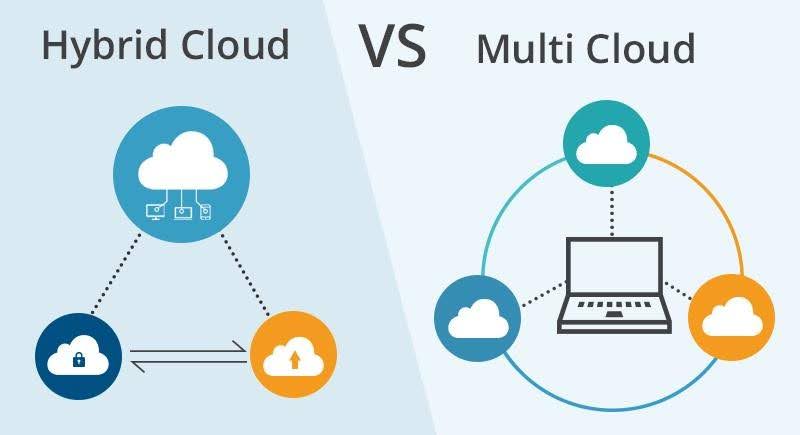
A hybrid cloud integrates on-premise infrastructure with public cloud environments, allowing workloads to move between the two.
This model is built on continuity — extending existing systems rather than replacing them.
It enables organizations to:
- Retain control over sensitive systems
- Gradually transition to the cloud
- Balance performance with scalability
Multi-Cloud: Diversifying for Agility
A multi-cloud strategy involves using multiple public cloud providers simultaneously, each serving a specific purpose.
This model is built on choice and optimization, selecting the best platform for each workload.
It enables organizations to:
- Avoid dependency on a single vendor
- Leverage specialized capabilities across platforms
- Build resilience through distribution
The Core Difference: Intent, Not Infrastructure
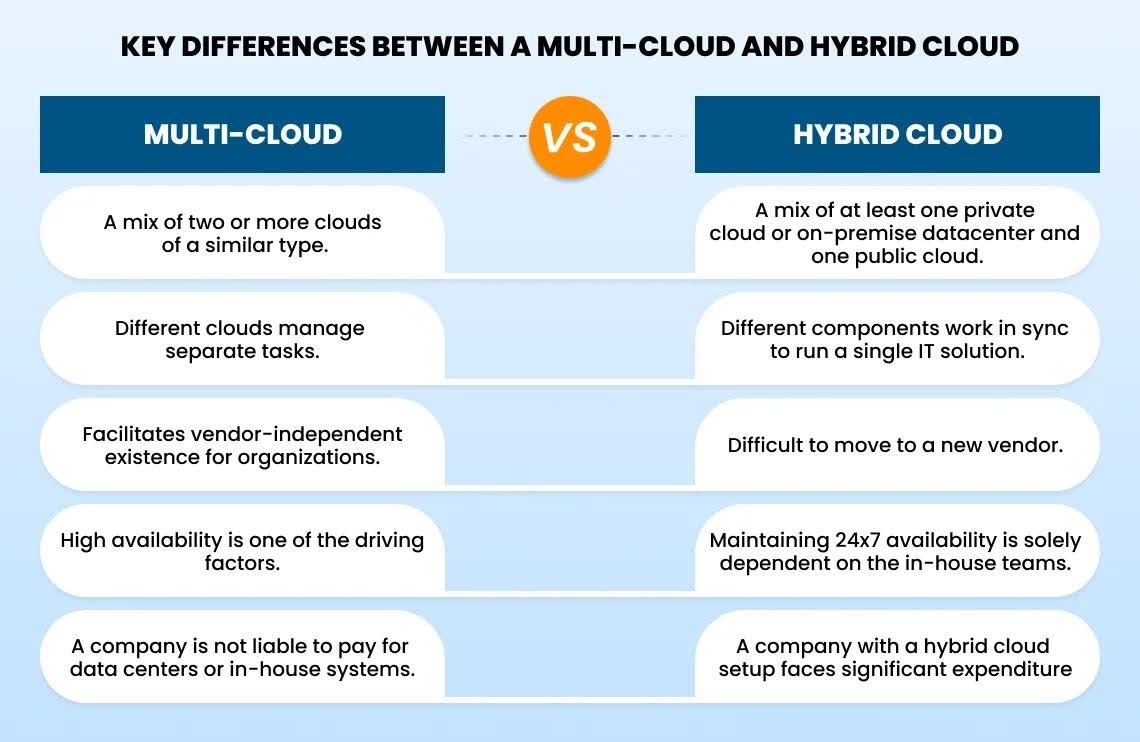
The distinction between hybrid and multi-cloud is not just architectural, it’s strategic.
- Hybrid cloud is about integration
- Multi-cloud is about diversification
Hybrid focuses on connecting environments.
Multi-cloud focuses on optimizing across environments.
Understanding this difference is key to making the right decision.
Where Hybrid Cloud Delivers Value
Hybrid cloud is particularly effective in environments where control, compliance, and continuity are critical.
It is best suited for organizations that:
- Operate in regulated industries such as healthcare, finance, or government
- Have significant legacy infrastructure investments
- Require low-latency systems tied to physical environments
- Prefer a phased approach to cloud adoption
In these scenarios, hybrid cloud provides a controlled path to modernization without disrupting core systems.
Where Multi-Cloud Creates Advantage
Multi-cloud becomes powerful when flexibility and resilience take priority.
It is ideal for organizations that:
- Want to avoid vendor lock-in
- Operate across multiple geographies
- Require high availability and redundancy
- Need access to best-in-class services across providers (AI, analytics, etc.)
In these cases, multi-cloud enables a more dynamic and competitive cloud strategy.
The Trade-Offs That Matter
Every cloud decision comes with trade-offs, and this is where most strategies fail.
Hybrid Cloud Challenges
Hybrid environments demand strong integration capabilities.
Managing consistency across on-prem and cloud systems can increase complexity, especially around security and orchestration.
Multi-Cloud Challenges
Multi-cloud introduces operational overhead.
Different platforms mean different tools, skill sets, and governance models, making visibility and cost control more difficult.
Cost Is Not Just About Infrastructure
One of the biggest misconceptions is evaluating cloud purely on infrastructure cost.
In reality:
- Hybrid cloud optimizes existing investments
It reduces unnecessary migration costs and leverages current infrastructure. - Multi-cloud optimizes long-term flexibility
It creates pricing leverage and avoids dependency-driven cost escalations.
The smarter approach is not choosing the cheaper option, but choosing the one that aligns with your cost structure over time.
So, What Should You Choose?
There is no universal answer, but there is a clear way to decide.
Choose hybrid cloud if your priority is:
- Control
- Compliance
- Stability
- Gradual transformation
Choose multi-cloud if your priority is:
- Flexibility
- Scalability
- Innovation
- Risk distribution
The Reality: Most Enterprises Will Need Both
Increasingly, organizations are not choosing between hybrid and multi-cloud, they are combining them.
A typical modern architecture looks like:
- Hybrid cloud for core systems and sensitive workloads
- Multi-cloud for innovation layers such as AI, analytics, and applications
This approach balances:
- Control with agility
- Stability with innovation
- Efficiency with resilience
Final Perspective: Strategy Over Architecture
The real question is not whether hybrid or multi-cloud is better.
The real question is:
What does your business need your cloud to do?
Because cloud is no longer just infrastructure, it is a strategic enabler of growth, speed, and competitive advantage.
The organizations that get this right are not the ones adopting the latest model, they are the ones designing intentional cloud strategies aligned with business outcomes.
If you’re evaluating your cloud roadmap, the focus shouldn’t be on choosing a model, it should be on designing the right architecture for your business context.
Because the right cloud strategy doesn’t just support your operations, it defines how fast you can evolve.