



Enterprise IT operations are becoming increasingly complex. Organisations now manage applications, infrastructure, networks, databases, and cloud environments spread across multiple platforms and locations. At the same time, expectations around uptime, security, performance, and service delivery continue to rise.
Traditional IT operations were built around teams responding to alerts, investigating incidents, and resolving problems through predefined processes. Automation helped reduce repetitive work, but many operational decisions still required human intervention.
Artificial intelligence is beginning to change this model.
With the emergence of AI agents, enterprises are moving beyond systems that simply identify problems or recommend solutions. They are exploring intelligent systems that can analyse operational conditions, plan actions, execute approved workflows, and learn from outcomes.
This shift is giving rise to autonomous IT operations: an approach in which AI and automation take on a growing share of infrastructure and service management activities, while human teams retain oversight of critical decisions.
For enterprise technology leaders, the opportunity is significant. But achieving meaningful autonomy requires more than deploying an AI tool. It requires a rethink of IT architecture, operational processes, data management, security, and governance.
1. From Traditional Automation to Agentic AI
Automation has been part of IT operations for years. Organisations use scripts, monitoring platforms, and predefined workflows to perform tasks such as restarting services, provisioning infrastructure, applying patches, and generating reports.
Traditional automation, however, generally follows instructions established in advance. It works well when conditions are predictable, but it can struggle when an issue involves multiple systems, changing circumstances, or decisions that require contextual understanding.
AI agents introduce a different approach.
An AI agent can interpret information, understand a defined objective, identify the steps required to achieve it, and interact with approved tools to carry out those steps. Rather than simply following a fixed sequence, it can respond to changing conditions within the boundaries established by the organisation.
For example, when an application experiences a performance issue, a traditional monitoring system may generate an alert and notify the IT team. An AI agent could go further by examining application logs, checking infrastructure metrics, identifying a likely cause, and initiating an approved remediation workflow.
This does not mean every AI agent operates independently or makes unrestricted decisions. Its capabilities depend on the tools it can access, the permissions it receives, the quality of available information, and the controls governing its actions.
The important shift is from task-based automation towards goal-oriented operations.
2. What Autonomous IT Operations Really Mean
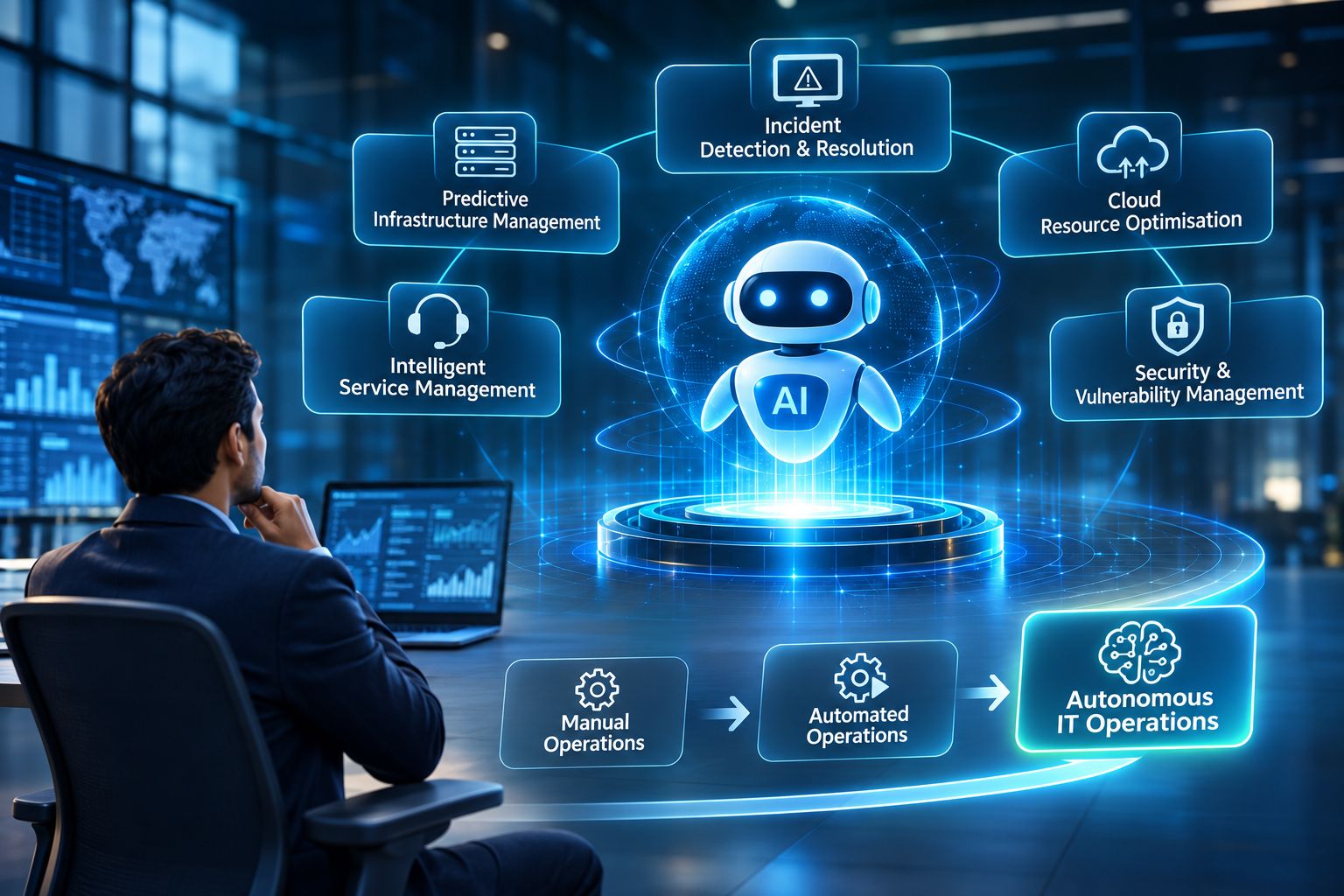
Autonomous IT operations refer to the use of AI, machine learning, automation, and integrated operational systems to monitor, manage, optimise, and resolve IT activities with progressively less manual intervention.
The objective is not necessarily to remove people from IT operations. It is to reduce the time teams spend on repetitive monitoring, routine troubleshooting, and predictable service requests, allowing them to focus on architecture, resilience, security, and strategic improvements.
In a mature autonomous IT environment, different capabilities work together:
- Continuous monitoring: Systems collect operational signals from infrastructure, applications, networks, and cloud environments
- Intelligent analysis: AI interprets patterns, identifies anomalies, and connects related events.
- Decision support: Agents evaluate possible responses based on context, policies, and operational objectives.
- Automated execution: Approved actions are carried out through controlled workflows and integrations.
Continuous evaluation: Results are monitored to determine whether the action resolved the issue or requires further investigation.
These capabilities can help organisations move from reactive incident management towards more proactive and predictive operations.
However, autonomy is not a single technology that can simply be switched on. It is a capability that develops as an organisation improves its infrastructure, data, automation, and governance foundations.
3. Where AI Agents Are Transforming IT Operations
The value of agentic AI becomes clearer when viewed through specific operational use cases.
-
Intelligent Incident Detection and Resolution
IT teams often receive large volumes of alerts from monitoring tools. Many are related, repetitive, or low priority, making it difficult to distinguish critical issues from routine operational noise.
AI agents can analyse these signals together, correlate events across systems, and help identify the underlying cause of an incident.
For example, a sudden application slowdown may be connected to a database bottleneck, increased network latency, or insufficient cloud resources. Instead of treating each alert as an isolated event, an AI-enabled system can investigate the relationships between them.
Depending on its permissions, the agent may recommend a solution, initiate a predefined remediation workflow, or escalate the issue to an engineer.
This can reduce investigation time and help IT teams respond more consistently.
-
Predictive Infrastructure Management
Infrastructure problems often develop gradually before becoming visible service disruptions.
Increasing memory consumption, storage pressure, unusual network activity, and changing workload patterns can indicate that an environment is approaching a performance or capacity limit.
AI systems can analyse historical and real-time operational data to identify patterns that may signal an emerging problem.
AI agents can then support actions such as generating capacity recommendations, initiating approved resource adjustments, or creating maintenance tasks.
This allows infrastructure teams to address potential issues earlier rather than waiting for a failure to affect users.
-
Automated Cloud Resource Optimisation
Managing cloud infrastructure involves balancing performance, availability, and cost. Resources may remain underutilised, workloads may require additional capacity, and consumption can fluctuate as business demand changes.
AI agents can analyse utilisation patterns, resource configurations, and workload requirements to identify optimisation opportunities.
They may recommend resizing resources, flag idle infrastructure, or trigger approved scaling workflows.
For enterprises operating across multiple cloud environments, this can support more consistent resource management and better visibility into infrastructure spending.
Any automated changes should remain within established cost, performance, and security policies.
-
Proactive Security and Vulnerability Management
Security operations involve monitoring an expanding range of endpoints, applications, identities, and infrastructure components.
AI agents can help analyse security alerts, correlate suspicious activity, prioritise vulnerabilities, and support investigation workflows.
For instance, an agent may identify an unusual login pattern, correlate it with other access events, and recommend further investigation or a controlled response.
In environments with appropriate safeguards, agents can also initiate predefined actions such as isolating an affected endpoint or disabling a compromised credential.
High-impact security decisions should remain subject to clear approval requirements, particularly when automated action could disrupt critical business operations.
-
Intelligent IT Service Management
Enterprise service desks handle a wide variety of requests, from password resets and access requests to software issues and infrastructure incidents.
AI agents can help classify incoming tickets, retrieve relevant knowledge articles, gather diagnostic information, and route requests to the appropriate teams.
For standardised and low-risk requests, they may also execute approved workflows, such as resetting credentials or provisioning access based on predefined policies.
This can reduce repetitive service desk activity and improve response consistency, while allowing support teams to concentrate on complex issues that require human judgement.
4. Why Autonomous IT Is Becoming an Enterprise Priority
The growing interest in autonomous IT is closely connected to the changing demands placed on infrastructure and operations teams.
Gartner’s October 2026 outlook identifies AI agents accelerating autonomous IT operations as one of the key trends for infrastructure and IT operations in 2027. Gartner predicts that by 2030, 50% of organisations will use AI agents with minimal human involvement in IT operations, compared with nearly none in 2026.
This points towards a significant shift in how enterprises will manage technology environments over the coming years.
Several business priorities are driving this transition.
Increasing operational complexity: Hybrid cloud, distributed applications, and interconnected infrastructure make manual monitoring and troubleshooting increasingly difficult to scale.
Demand for faster resolution: Businesses expect critical applications and services to remain available. Delays in identifying and resolving incidents can affect productivity, customer experience, and revenue.
Pressure to optimise costs: Organisations need to manage infrastructure consumption, reduce unnecessary operational effort, and make better use of existing technology investments.
Limited availability of specialised skills: IT teams need to manage increasingly sophisticated environments, even as demand for specialised cloud, security, and infrastructure expertise grows.
The need for continuous operations: Digital services increasingly operate around the clock. AI-enabled monitoring and controlled automation can help organisations respond to operational changes beyond conventional working hours.
Together, these factors are encouraging enterprises to explore AI as an operational capability rather than simply another productivity tool.
5. The Challenges Enterprises Must Address Before Adopting Autonomous IT
Despite its potential, autonomous IT introduces a new set of operational considerations. An AI agent that can access enterprise systems and execute actions must be governed differently from an AI assistant that only provides recommendations.
Data Quality and Operational Visibility
AI agents depend on reliable information to make useful decisions. If monitoring data is incomplete, outdated, inconsistent, or spread across disconnected systems, the agent may fail to understand the actual condition of the environment.
Enterprises need a strong observability foundation that brings together relevant information from applications, infrastructure, networks, endpoints, and cloud platforms.
Without sufficient visibility, autonomous decision-making can become unreliable.
Security and Access Management
AI agents may require access to infrastructure management tools, databases, cloud platforms, and enterprise applications to complete their tasks.
These permissions must be carefully controlled.
Organisations should assign agents distinct identities, apply least-privilege access, define permitted actions, and regularly review their permissions. Sensitive operations should require additional approval where necessary.
An agent should only have the access needed to fulfil its assigned responsibilities.
Governance and Human Oversight
Not every IT decision should be automated.
A routine service restart may be suitable for an approved automated workflow, while a major infrastructure change or security action could require human review.
Enterprises need to establish clear boundaries between actions an agent can execute independently, actions requiring approval, and decisions that must remain with qualified personnel.
They should also maintain records of agent activity, including the information used, decisions made, actions executed, and outcomes observed.
This creates accountability and makes it easier to investigate unexpected behaviour.
Integration With Existing IT Environments
Most enterprises operate a combination of legacy applications, modern cloud platforms, third-party services, and on-premises infrastructure.
Introducing AI agents into this environment requires reliable integrations and consistent workflows.
If systems use different data formats, disconnected monitoring platforms, or inconsistent operational processes, agents may struggle to access the information and tools required to perform their tasks.
Modernisation and integration are therefore important parts of an autonomous IT strategy.
Cost and Performance Management
AI agents introduce additional infrastructure and consumption costs. Complex workflows may involve multiple model interactions, API calls, and automated actions.
Without usage monitoring and cost controls, the expense of running autonomous workflows can grow unexpectedly.
Enterprises should track agent activity, measure the cost of individual workflows, and assess whether automation is delivering measurable operational value.
6. Building a Roadmap Towards Autonomous IT Operations
Moving towards autonomous IT requires a phased approach. Organisations should begin with clearly defined operational challenges and expand automation as the underlying environment becomes more mature.
Step 1: Assess the Existing IT Environment
Start by evaluating infrastructure, applications, monitoring tools, automation workflows, and operational processes.
Identify repetitive tasks, frequent incidents, manual dependencies, and areas where better visibility could improve decision-making.
This assessment helps establish where AI agents can deliver practical value.
Step 2: Strengthen Data and Observability Foundations
Consolidate relevant operational data and improve visibility across infrastructure and applications.
Monitoring systems should provide accurate, timely information that can be accessed by authorised AI tools.
Data quality, consistency, and context are essential because an agent’s decisions are only as reliable as the information available to it.
Step 3: Identify Suitable Use Cases
Begin with specific, measurable use cases rather than attempting to automate entire IT operations at once.
Incident classification, ticket routing, log analysis, capacity recommendations, and routine troubleshooting are potential starting points.
Choose use cases with clearly defined outcomes, manageable risks, and reliable ways to measure performance.
Step 4: Establish Governance and Guardrails
Define agent identities, access permissions, approval requirements, escalation processes, and audit mechanisms before expanding autonomous execution.
Organisations should also establish testing and rollback procedures for automated infrastructure changes.
Governance should be integrated into the operational workflow rather than added after deployment.
Step 5: Introduce Controlled Automation
Start with AI-assisted recommendations and human-approved actions. Once performance and reliability have been established, selected low-risk workflows can move towards greater autonomy.
This gradual progression helps teams build confidence in the system while identifying weaknesses before they affect critical services.
Step 6: Measure, Improve, and Scale
Evaluate the impact of AI agents using operational indicators such as:
- Mean time to detect and resolve incidents.
- Number of incidents successfully resolved through approved automation.
- Application and infrastructure availability.
- Frequency of unnecessary alerts.
- Cloud resource utilisation and operating costs.
- Number of automated actions requiring human intervention.
Use these insights to refine workflows, improve data quality, and expand successful use cases across the enterprise.
7. The Changing Role of IT Teams
As AI agents take on more operational responsibilities, the role of IT professionals will continue to evolve.
Rather than spending most of their time responding to alerts, handling routine tickets, or executing repetitive procedures, teams can devote more attention to architecture design, infrastructure resilience, security strategy, capacity planning, and technology optimisation.
New responsibilities will also emerge around agent management. Enterprises will need professionals who can design agentic workflows, manage permissions, evaluate AI performance, monitor operational behaviour, and maintain governance standards.
This makes human expertise more important, not less. AI can process information and execute defined actions at scale, but people remain essential for setting objectives, evaluating business impact, handling exceptions, and taking responsibility for critical decisions.
The most effective operating model will bring together human judgement, AI-driven intelligence, and reliable automation.
8. The Future of IT Operations Is Autonomous, but Governed
Autonomous IT represents a fundamental evolution in enterprise technology management. It moves organisations beyond isolated automation towards connected systems that can monitor environments, interpret operational signals, and execute approved actions with increasing independence.
However, autonomy without visibility, governance, and control can introduce new risks rather than solve existing problems.
Enterprises must first establish reliable infrastructure, integrated data, consistent processes, and strong security foundations. AI agents can then build on these capabilities to make IT operations more responsive, efficient, and resilient.
For organisations planning their next phase of digital transformation, the question is no longer simply how to introduce AI into IT operations. It is how to redesign the operating environment so that AI can work safely and deliver measurable business value.
The future of enterprise IT will not be defined by how many tasks organisations automate, but by how intelligently they connect people, infrastructure, and AI to keep business operations running.